Home

Thursday, February 25, 2016

10 Questions with Professor Bob Grese

Bob Grese is Director of the Matthaei Botanical Gardens and Nichols Arboretum and professor and the Theodore Roosevelt Chair of Ecosystem Management in the University of Michigan School of Natural Resources & Environment (SNRE). His teaching and research involve ecologically-based landscape design and management that respects the cultural and natural history of a region.

The SNRE publishes a monthly e-news that includes a Q&A in which faculty answer questions posed to them by alumni and friends. Here is this month's Q&A with Bob.
Above: Bob Grese. Photo by Dave Brenner.

1. What is the first step in changing residential traditional landscapes that require supplemental irrigation to sustainable landscapes that survive off of normal yearly rainfall? - Chris Charles MLA '04
First, I think it’s important to get to know what grows naturally in the region. Find some local natural areas that could serve as a model for idealizing in a smaller residential yard.

2. Who have been some of your biggest influences in shaping your ideas on sustainability? Any books or authors you'd recommend? - Grace McGinnis MS '16
I’ve spent much of my career studying the work of late 19th and early 20th century designers who took their cues from nature, especially Jens Jensen and O.C. Simonds. I’d be remiss not to mention them and their writings. The writings of Nan Fairbrother and May Thielgaard Watts influenced me to go into landscape architecture. All of these people wrote about sustainability before it had a name.

3. What is your favorite place at the Arb or Matthaei and what changes are you most proud of there since becoming Director? - Jan Mueller MLA '93
Over the years, the prairie in Dow Field has become a special place for me, especially in the fall when the grasses are full height and wave in the wind. What am I most proud of? Mostly that I see so many people enjoying these places and connecting with nature. That makes all the work we’ve done worthwhile.

4. What keeps you up at night?
Very little. I fall asleep almost immediately

5. What is the most adventurous thing you’ve ever done?
Just after graduation from high school, I took the train up to Montana and worked in Glacier National Park as a busboy in one of the restaurants in the park. For a kid who’d never been north or west of Missouri, it was a true adventure and opened my eyes to the Rockies. I was away from home from June until Thanksgiving break my freshman year. I’m not sure my folks appreciated me being gone so long for my first time away.

6. If you could relive one SNRE experience what would it be?
I loved the old Paul Bunyan Balls.  They were such an active, joyful time!

7. If you could live in a different time period what time period would you live in?
I would have loved to see the oak openings of Washtenaw and Oakland County before they were changed by European settlers. Similarly, I would have loved to see the San Francisco Bay area.

8. What did you want to be when you were a kid?
I always thought I would be an architect.  I got a set of Lego bricks somewhere around 3rd or 4thgrade and built some pretty mean houses.  I actually studied architecture my first two years of college but transferred to landscape architecture in my junior year. 

9. What was the first concert you attended?
I have vivid memories of music associated with outdoor church gatherings growing up—specifically Easter sunrises services my father (who was a minister) held on Missionary Ridge in Chattanooga. I also remember a church picnic where some of my classmates' parents brought out a base fiddle and regular fiddle and began to play old-time music. Somehow music and the outdoors seemed so natural.  When I was in high school in Memphis, I went to a number of concerts by music groups popular in the early 70s, but the most memorable concert was one at my high school where a classmate mesmerized us all with her magical rendition of “The St. Louis Blues” by W.C. Handy. I’ve never heard anyone else sing it as well.

10. What is your favorite dessert?
Ice cream. Going to University of Wisconsin for graduate school was particularly dangerous for me.  I hung out a lot at the dairy store there.

Bonus Questions

What is your favorite outdoor activity? 
Gardening. I love watching things grow.

What is your favorite movie? 
To Kill a Mockingbird.

Describe your first job. 
Raking leaves.  My dad offered to pay me 5¢/wheelbarrow full, and I must have raked at least a hundred loads of leaves.  I don’t think I was ever paid, so maybe it doesn’t really count as my first job. 

What is the best award you’ve ever received?
At my junior high school, medals were given to the top students in each class. I won medals in five of my classes in 9th grade--Algebra, Art, Civics, English, and Latin.  When I went up to receive the last of these, my classmates and teachers gave me a standing ovation.  For a self-conscious kid at a new school that year, that meant a lot to me.

What is your favorite book?
Growing up in the south, I’m still partial to a number of southern writers—Flannery O’Connor, Eudora Welty, and William Faulkner.  I also love books by Willa Cather, especially My Antonia.

Wednesday, November 18, 2015

A Gift of Bonsai

Donor and University of Michigan alumnus Melvyn Goldstein’s gift of his entire collection of bonsai—together with funds to help care for the collection—will elevate the bonsai and penjing collection at Matthaei Botanical Gardens & Nichols Arboretum to national prominence.

By Joe Mooney

Three bonsai—a Korean hornbeam, a Japanese black pine, and a narrow-leaf Ficus—arrived to great excitement at Matthaei this fall. The trees are just a fraction of Melvyn Goldstein’s large assemblage of bonsai and the first wave of his collection, which he plans to donate in its entirety over the next few years. Goldstein is also donating funds for the care and maintenance of the collection, which represents his lifetime dedication to acquiring, stewarding, and refining
the plants—nearly 110 in all.

A satsuki azalea on display at Matthaei in the spring of 2015.
Melvyn Goldstein has several of these azaleas in his collection, and a
display of the satsuki is planned for May 2016. All of Goldstein's
satsuki azaleas will be included in his gift to us.

The Korean hornbeam that arrived at Matthaei as part of the
first wave of bonsai in the fall of 2015.

A Japanese white pine in Melvyn Goldstein's collection.
It’s difficult to overstate the importance of this gift. According to respected bonsai educator and lecturer Jack Wikle, acquiring these bonsai has the potential for making Matthaei’s display one of the top public collections of bonsai in the United States.

Among bonsai artists, Goldstein’s private collection is recognized as one of the finest in the United States. William Valavanis, who has studied in Japan and apprenticed with Japanese bonsai masters for 30 years, wrote after a recent “bonsai road trip” that included a stop at Goldstein’s Ohio home, “I’ve seen [his] fine bonsai for years at the US National Bonsai Exhibition but was not prepared to see the vast number of beautiful, well-cared-for [bonsai] so well displayed in his garden.”

A U-M alumnus and Tibetan scholar at Case Western Reserve University in Cleveland, Goldstein began his journey with bonsai nearly 50 years ago. In part his association with us rekindled feelings about his time at U-M. It was also time to think about who would take care of a collection that’s been decades in the making, says Goldstein, who is in his 70s. “I’m at a point in my life where it makes sense for me to turn over the care of my bonsai to others,” he says. “I’m excited about this collaboration as it gives me great satisfaction to be able to combine helping my alma mater, fostering knowledge and appreciation of the bonsai art form I love, and also knowing I have a wonderful home for my trees.” Goldstein adds that his Japanese azalea teacher always emphasized that we don’t own trees. Rather “we are just ‘leasing’ them until we pass them on to others who will continue looking after them. I truly believe this!”

Melvyn Goldstein riding a yak in Tibet. Goldstein’s
interest in bonsai started when he went to conduct
research in Tibet via Beijing, where he first encountered
beautiful Chinese bonsai up close and decided he had
to learn the art. During his research 
among a group
of high-altitude pastoral nomads in Tibet it was often
necessary to 
travel by horse or yak between the dispersed
campsites.
 Goldstein's research is discussed in an article he
wrote with his colleague Dr. Cynthia Beall 
in the June 1989
issue of National Geographic Magazine
titled, “The Remote
World of Tibet’s Nomads.”

Bonsai is a patient art and a long-time practice. Like their full-size cousins, bonsai often exist on a time scale beyond a single human life. The best trees may take decades to reach an apogee of refinement and even then, as living works of art they constantly change. The sheer number of plants that will find their way into our collection is only part of the story. It’s also the quality of the plants that will make our collection great—especially with Goldstein’s gift in place. “Dr. Goldstein’s trees are by far some of the best bonsai I’ve had the privilege of viewing anywhere in the world,” says Tennessee native Bjorn Bjorholm, a rising star in the bonsai world. “He has managed to single-handedly improve the quality of bonsai art in the United States.”


Caring for Bonsai—a Long-Term Commitment
The Plant Collections Network at the American Public Gardens Association describes Matthaei-Nichols as “among a prestigious group of gardens and arboreta that have committed themselves to the conservation and care of specific plant collections curated at the highest professional level.”

A recent portrait of Melvyn Goldstein.
Building sufficient endowments for the care and upkeep of our gardens and collections is a top campaign goal. We need your help to ensure their future by making a donation to the garden endowment fund.

Donations can be made using the enclosed envelope; online at mbgna.umich.edu, or by contacting our Director of Development Gayle Steiner: gayles@umich.edu; 734.647.7847.


Friday, October 9, 2015

Progeny of an Ancient Giant, a Coastal Redwood Grows at Matthaei Botanical Gardens

By Joseph Mooney

A young sprout from one of nature's power carbon keepers—the California coastal redwood— is on display at the University of Michigan Matthaei Botanical Gardens in Ann Arbor, Mich. The sapling is from the roots of the celebrated Fieldbrook stump, one of California’s largest redwoods felled nearly 125 years ago.

Among the planet’s oldest living organisms, coastal redwoods (Sequoia sempervirens) inspire awe with their immense size and longevity.

The Fieldbrook sapling in one of the greenhouses at Matthaei.


Matthaei-Nichols is fortunate to have an example of this North American icon—although on a smaller scale. It came to us as a sapling grown from the tissue of a root of one of the largest coastal redwoods ever recorded. The young tree, which measures about three feet high, is on display beginning October 12 at Matthaei Botanical Gardens.

The sapling is genetically identical to a tree cut down in Humboldt County, California in the late 1800s. The original tree measured over 30 feet in diameter (not including the bark) and its stump could easily accommodate dozens of people, as shown in the undated picture at left taken by A.W. Hendrickson (photo © Humboldt State University). Many trees---redwoods among them---send up sprouts or suckers after the parent tree has been felled or damaged, allowing the tree to regenerate. One family of trees native to Michigan, the ashes, exhibits this trait.


Some interesting facts about giant coastal redwoods:

  • ·         Their bark can be as much as 12 inches thick. This makes the trees resistant to fire damage.
  • ·         The trees may live up to 2,000 years
  • ·         Their branches may be as wide as 5 feet in diameter
  • ·         The trees may reproduce by seed or by sprout
  • ·         Coastal redwoods grow taller than giant sequoias, but giant sequoias tend to be larger in girth and weight.
  • ·         With its combination of longitude, climate, and elevation the north coast of California provides the unique environment required for the coastal redwood to thrive.
  • ·         Only 4% of the redwoods’ original 2 million acres of historic range are left.


A similar tree, although a different species, is the giant sequoia (Sequoiadendron giganteum). Giant sequoias thrive in higher elevation habitats than giant redwoods and grow naturally only along the western slope of the Sierra Nevada Mountains, primarily between 5,000 and 7,000 feet in elevation.*

Burt Barnes, a professor emeritus at the U-M School of Natural Resources and Environment, gave the tree to Matthaei-Nichols in September 2013. Barnes, who died in 2014, received the tree from David Milarch, founder of the Archangel Ancient Tree Archive. Matthaei-Nichols plans to donate the tree to a botanical garden or organization that can plant it in the best conditions for it to thrive.

The sapling will be on display in the conservatory at Matthaei for several weeks. To learn more about the coastal redwood click here for an article from the National Park Service. If you've never traveled to California to visit the coastal redwoods or sequoias, this is an opportunity to see what a young tree looks like and imagine how large it might grow given enough time and the right conditions.


Source: Sequoia & Kings Canyon National Parks website.

Friday, October 2, 2015

U.S. Fish and Wildlife Service Proposes to List Eastern Massasauga Rattlesnake as Threatened Species


The U.S. Fish and Wildlife Service has just issued a press release about a proposal to list the eastern massasauga rattlesnake as a threatened species under the Endangered Species Act.

Click on the link below to read the release, which also contains information on how the public can weigh in on the proposal:

Friday, September 11, 2015

Mushrooms, the Hidden Gems of the Forest

By Andrew Harmon

This summer I worked with the Natural Areas team at Matthaei Botanical Gardens & Nichols Arboretum. Over the course of four months we scoured hundreds of acres on four properties, finding and removing invasive plants and conserving precious habitats. Aided by an unusually wet spring and summer we also found a plethora of fascinating fungi, gems of color peeking out from the leaf litter. With fall just around the corner it seems appropriate to introduce just a few of the many fungi that can be found around the Matthaei-Nichols properties.

Every fall mycophiles take to the woods, poring over dead stumps and downed logs in their search for mushrooms. These mushrooms are the ephemeral reproductive structures of organisms that are almost invisible throughout the majority of the year. They are valued for their culinary uses, medicinal properties, strange and unique forms, and beautiful colors.

Although many mushrooms are cosmopolitan species that fit into very broad ecological niches, many also rely on very specific environmental conditions. For example the oyster mushroom (Pleurotus ostreatus) can be grown on straw soaked with diesel fuel. In contrast the American matsutake (Tricholoma magnivelare) is only found in jack pine forests, and even then not often. Some research has even indicated that the abundance of certain mushroom species can be used as a proxy indicator for forest health. Most of the mushrooms described here were found in some of the best areas of habitat that we manage. Their presence tells us that these are areas with a rich diversity of living things, many of which are not easily observed, and that our conservation work is helping to sustain these increasingly uncommon habitats.

Caution: Fungi constitute an important and delicious part of the cuisines of many cultures. However, fungi in general are poorly understood relative to other organisms, and even highly trained professionals cannot always agree on what to call certain species. In fact many mushroom species, including some of the popular edibles, have recently been found to actually be groups of several different visually identical species that may or may not be equally edible. Added to this confusion is the fact that certain fungi---which look, smell, and taste delicious by the way---contain some of the most potent toxins found in nature. If you are interested in learning more about fungi for fun or feasting I highly recommend that you seek the expert guidance of an experienced forager, take a class in field mycology, or look for guided forays with local mushroom hunting clubs (often called "guilds").

Author's note: While preparing this post I turned to two sources for invaluable information and guidance. One is mushroom expert Michael Kuo's website mushroomexpert.com; the other is George Barron's book Mushrooms of Northeast North America (Lone Pine, 1999).

 
One of the first of the season was the coral fungus (Artomyces pyxidata). It can be found exploding out of
the well-rotted logs that it feeds on discreetly the rest of the year.


This iridescent little mushroom
was found along Fleming Creek,
peeking out from the moss and leaf
litter. Its name is 
Entoloma incanum
and it survives by breaking up and
digesting organic matter in the soil.


Another mushroom that has been abundant since
early in the summer is this fleshy "jelly fungus"
(
Auricularia auricula). It is commonly known as
the “wood ear” fungus and is actually a common
edible. In fact, if you have ever been treated to a
truly traditional Chinese hot-and-sour soup then
you have probably already enjoyed it!


While we are on the subject of
jelly fungi here is an unusual
specimen. 
Tremella reticulata
can be found fruiting on the
ground throughout the summer
and fall, presumably feeding on
rotting wood buried just below the soil’s surface.


This is Schizophyllum commune, one of the most
widely distributed fungi on the planet. It has even
been found growing inside the human mouth. . . .
So remember kids, brush your teeth!


.


Mycena leaiana is a smaller mushroom
that grows in large clusters. Its neon orange
caps and stems can be seen from a long way off,
all but glowing in the shade of the forest


Speaking of glowing mushrooms,
this is the season for 
Omphalotus illudens,
the jack-o'-lantern mushroom. The underside
of the cap and gills actually glow in the dark!
It is one of a number of bioluminescent fungi
that can be found gently lighting the trails at
night if conditions are just right.


While we are on the topic of orange mushrooms
here is a particularly special one, 
Cantharellus cinnabarinus,
the cinnabar chanterelle. Chanterelles are a popular
edible mushroom with a history of use in fine cuisine.
However, their mysterious lifecycle has managed to
frustrate any attempts at commercial production.
As of right now any chanterelle being sold in farmers
markets or grocery stores has been harvested out of the wild.


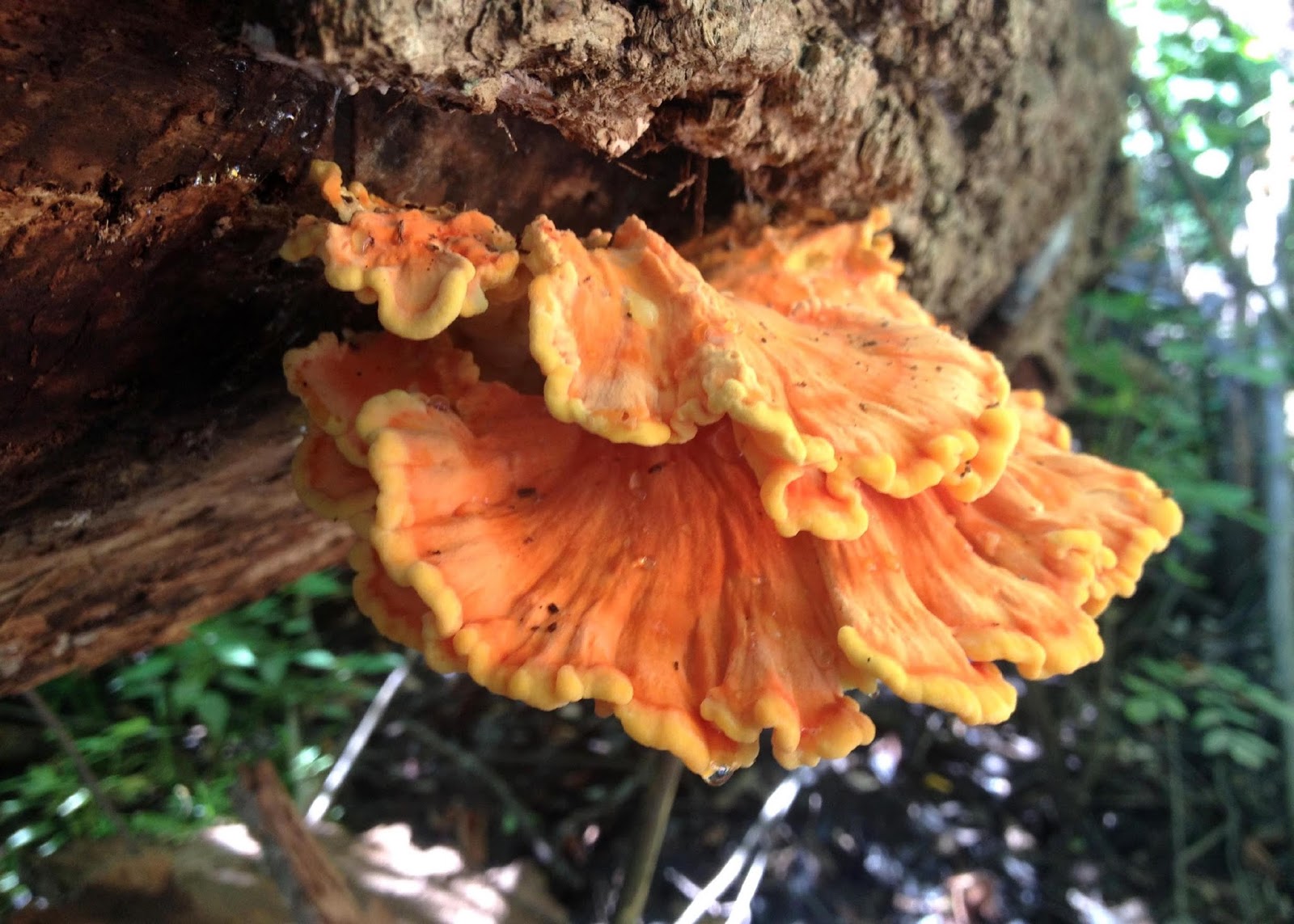
Another orange edible! Chicken of the woods,Laetiporus sulpherus, is one of the most easily
recognized mushrooms in the woods. The outer
parts of this mushroom can be eaten and are
really quite good, however be prepared for the
real wild foods experience as you cut out the
grub-infested sections before cooking.


Here is another easily recognized edible,
and one of my personal favorites. The hen
of the woods or miatake (
Grifola frondosa)
erupts from the base of oaks and maples in
such massive clusters that just one can provide
a meal for weeks. This one was just one of
several bunches and weighed in at over six
pounds! (Full disclosure: I actually harvested
this particular mushroom behind my parents’
house while I was visiting this summer.)


A cousin of the miatake is this
massive mushroom, 
Bondarzewia berkeleyi.
We found this mushroom near the base of
a massive oak in a savanna near the northern
boundary of Matthaei. 
B. berkeleyi is a
parasite that causes butt rot in trees and its
presence indicates that that old oak will
someday in the near future be making room
in the canopy for one of the waiting saplings below.


While searching for a particular patch of
invasive plants at the Nichols Arboretum
we stumbled upon a bunch of old hemlock
trees that had been cut into logs and left
to decompose. Enter 
Ganoderma tsugae,
the hemlock varnish shelf. This mushroom
is closely related to the famed reishi
mushroom (
Ganoderma lucidum) and
is nearly indistinguishable in the field
except for its choice of tree to decay
.


Recently there have been a number of these
mushrooms peeking through the leaf litter. 
Gyroporus purpurinus is symbiotic with the
roots of hardwood trees in what is known as
a mycorrhizal relationship. The tree and the
fungi grow together and exchange nutrients,
each providing something that the other needs.


Sometimes, when you are really looking closely
at nature a surprise pops out at you. This mushroom, 
Marasmius siccus, is only a couple of centimeters
tall and stunningly delicate.


No collection of mushroom photos would be complete
without a slime mold thrown in for good measure.
Here is one of my favorites, 
Stemonitis fusca.
Its little huts look to me like fantastical dwellings
rising above a strange landscape.


Andy Harmon, from Kalamazoo, Michigan, is working on a Master’s of Science in Natural Resources and Environment with a concentration in Conservation Ecology and Environmental Informatics. His interests include Midwest agricultural landscapes that support biodiversity through agroforestry practices. Andy’s internship is funded by the National Fish and Wildlife Fund.